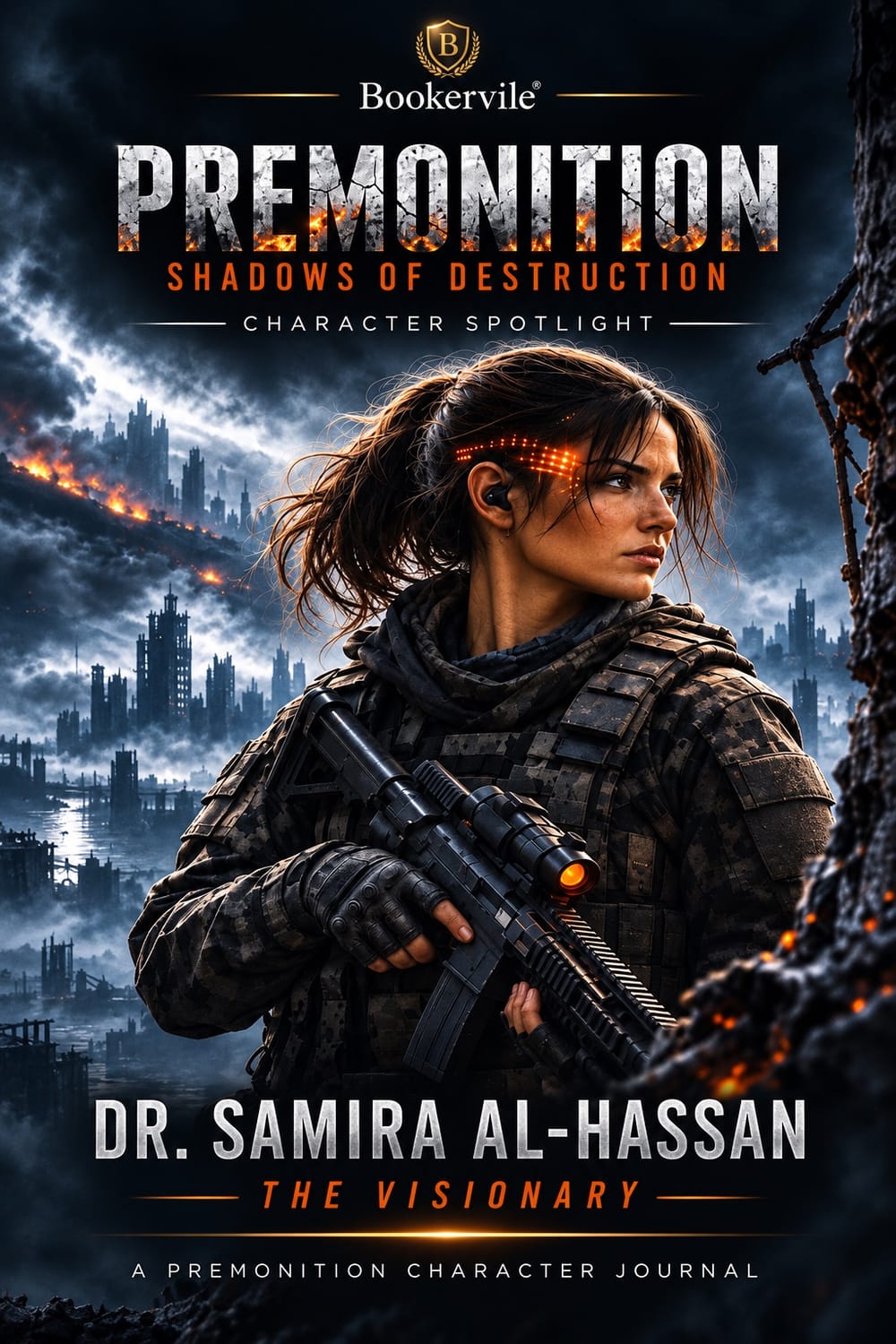
Character Journal · 01
Dr. Samira Al-Hassan
A woman carrying the burden of warnings others struggle to believe.
Read the journal →
Premonition · Character Journal
Explore five character spotlights from Premonition: Shadows of Destruction. Start with Samira’s warning, follow Ghost Lance, and discover the human stakes behind the crisis.
Character Journal · 01
A woman carrying the burden of warnings others struggle to believe.
Read the journal →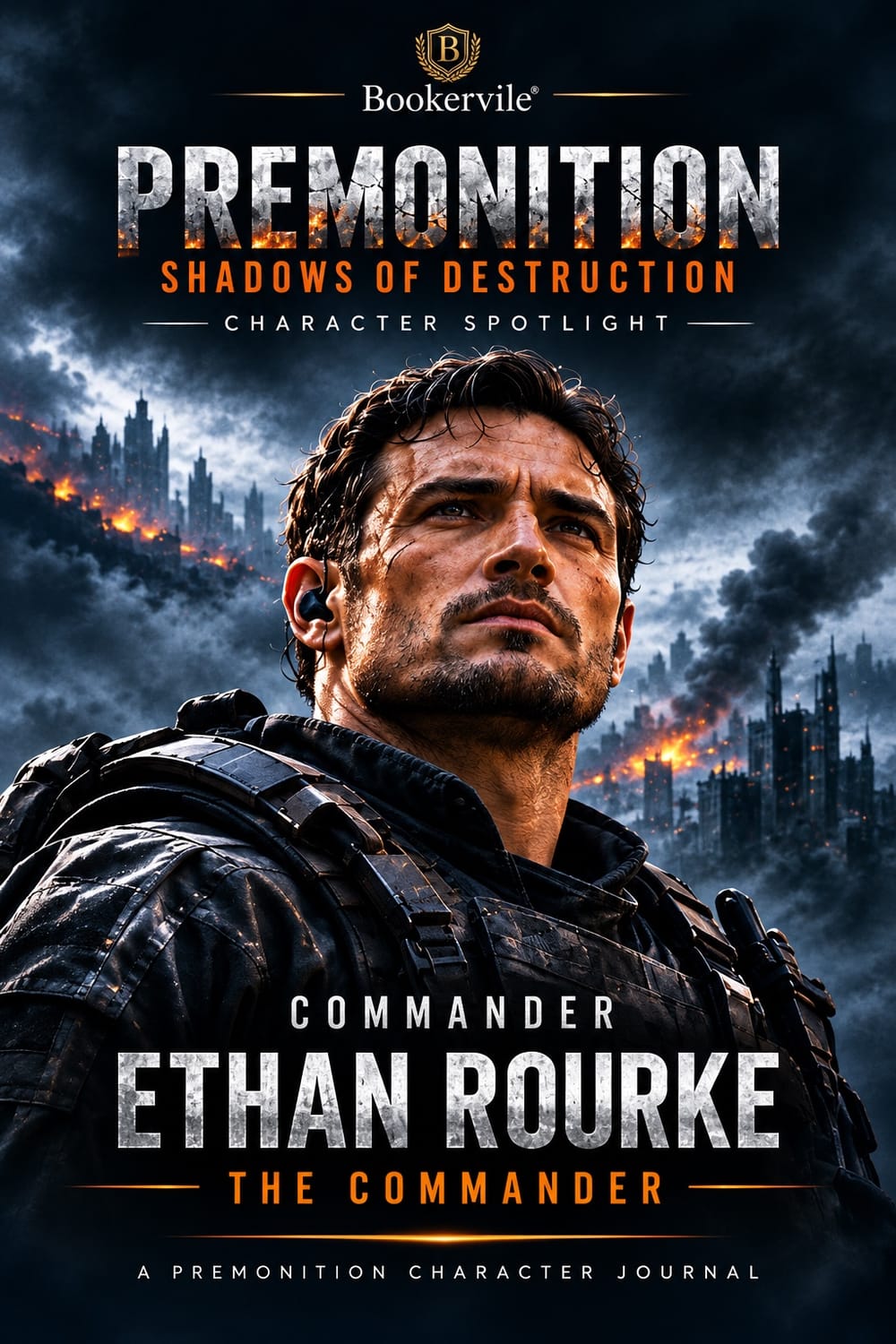
Character Journal · 02
Leadership, judgment, and the human cost of command.
Read the journal →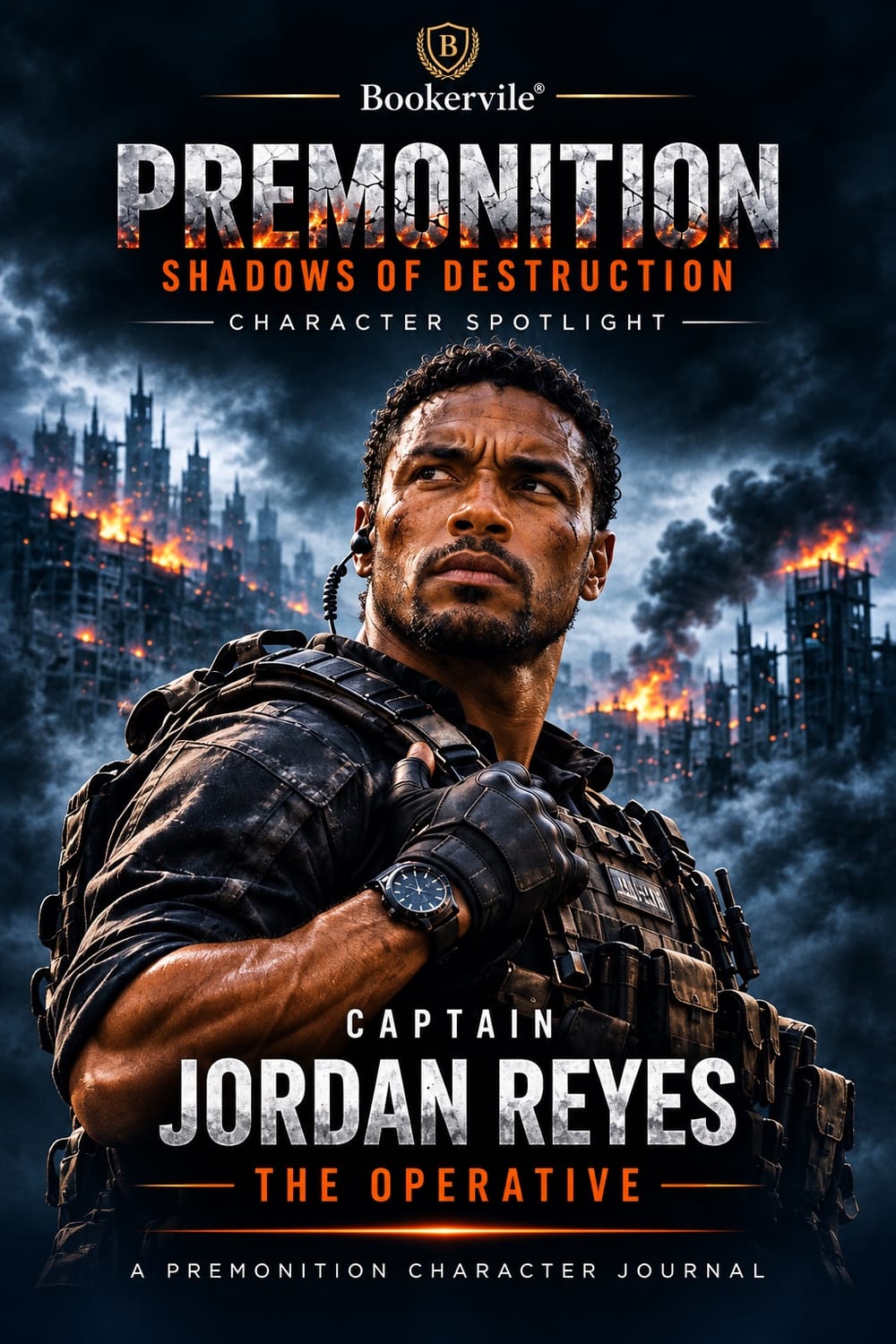
Character Journal · 03
The decisions behind a mission where innocent lives are at stake.
Read the journal →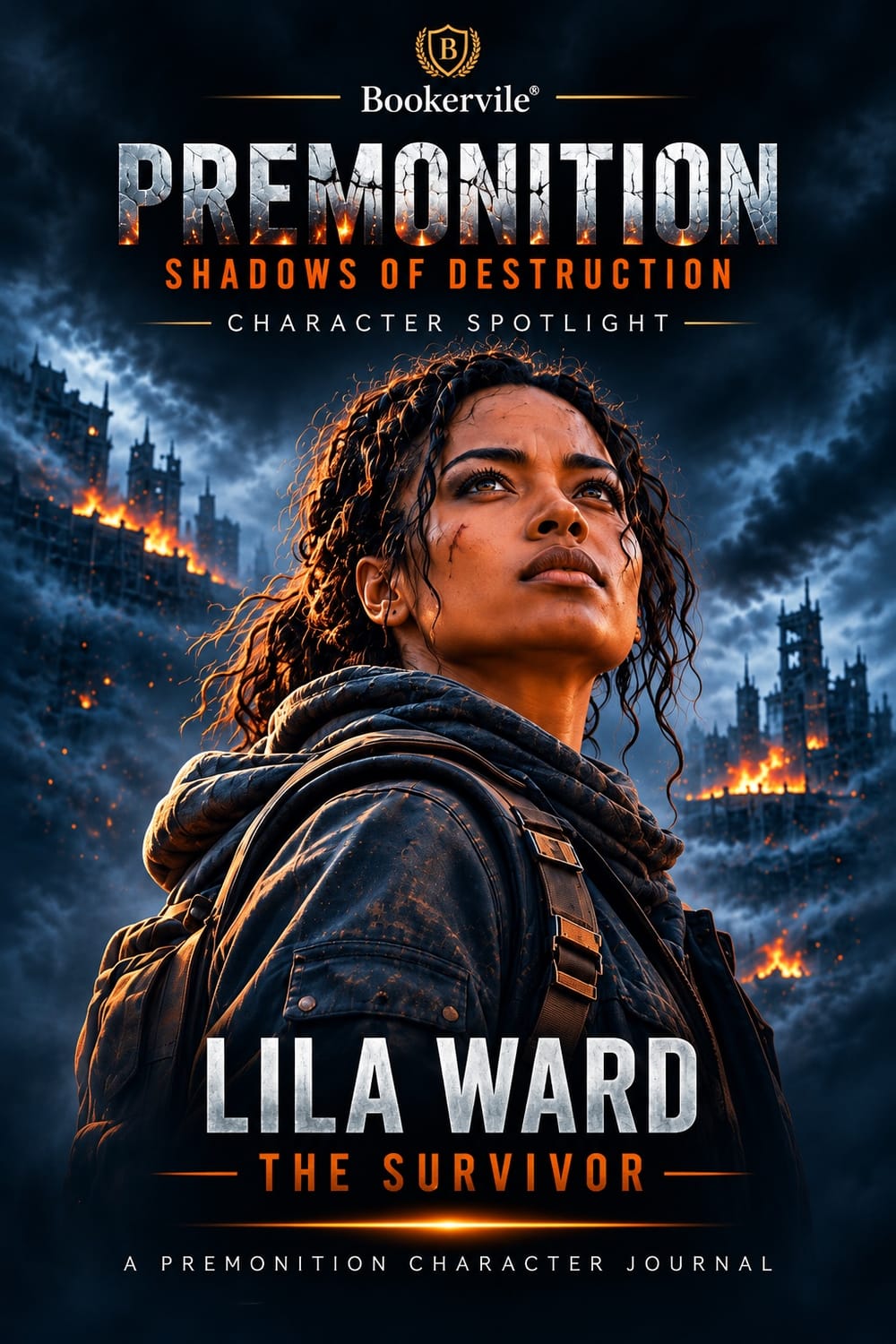

Character Journal · 05
The mysterious strategist behind a campaign of calculated destruction.
Read the journal →Premonition: Shadows of Destruction — Character Spotlight 01
What would you do if you could see a catastrophe coming—but couldn't convince anyone to believe you?
For Dr. Samira Al-Hassan, that question is no hypothetical exercise.
In Premonition: Shadows of Destruction, the techno-thriller novel by Levon Booker, Samira finds herself confronting a terrifying possibility: that the images appearing in her mind may be warnings of events yet to unfold.
And time is running out.
In a quiet apartment in Riyadh, Samira studies satellite feeds, intelligence reports, and encrypted communications. What appears to others as disconnected information reveals patterns to her.
But her abilities reach beyond conventional analysis.
She experiences frightening visions of destruction—images of cities under attack, countless lives in danger, and an even greater catastrophe looming on the horizon.
The implications are almost impossible to comprehend.
Yet Samira understands one thing: ignoring these warnings could have devastating consequences.
Samira's journey takes her to Washington, D.C., where she faces an entirely different challenge.
How does someone persuade powerful institutions to act on information they cannot independently explain?
She must confront skepticism, institutional hesitation, and the burden of knowing that delay could cost lives.
Her struggle introduces one of the novel's central questions:
When the evidence seems impossible, what does it take for someone to listen?
Samira's determination becomes as important as her extraordinary perception.
Knowledge is often described as power.
But in Samira's world, knowledge can also become a burden.
Every warning carries responsibility. Every unanswered question increases the pressure. And behind the growing threat lies a mysterious adversary known as the Architect.
As the crisis escalates, Samira must understand the patterns connecting the destruction before the opportunity to prevent something even worse disappears.
Her greatest challenge may not simply be understanding what she sees.
It may be discovering what those visions demand of her.
Dr. Samira Al-Hassan introduces readers to a world where intelligence, uncertainty, human judgment, and extraordinary perception collide.
Her story begins with a warning.
Where it leads is part of the mystery.
Discover Premonition: Shadows of Destruction, Book One of Premonition, by Levon Booker.
Explore the novel at bookervile.com/shadowsofdestruction.
Part of Bookervile's Character Spotlight series—introducing the people, conflicts, and stories behind our novels.
Continue with Samira → Seeing What’s Coming
Premonition: Shadows of Destruction — Character Spotlight 02
When a nation's future hangs in the balance, leadership becomes more than giving orders. It becomes deciding whom to trust—and what risks are worth taking.
In Premonition: Shadows of Destruction, the techno-thriller by Levon Booker, Commander Ethan Rourke leads Ghost Lance, the elite field unit of SPEAR Division.
He is a man accustomed to danger, uncertainty, and decisions that cannot wait.
But the threat confronting his team is unlike any ordinary military operation.
As reports of devastating attacks spread, government officials race to understand the enemy's intentions.
Information is incomplete. Fear is escalating. And every delay carries consequences.
Rourke must prepare his team to respond while the full scale of the threat remains unknown.
His command demands more than tactical knowledge. It requires judgment, coordination, and the ability to keep people focused when the situation threatens to overwhelm them.
For Rourke, composure is not the absence of concern. It is the discipline to act despite it.
Dr. Samira Al-Hassan brings an extraordinary dimension to the crisis.
Her visions suggest a pattern behind the destruction, yet the information she provides challenges conventional ways of understanding intelligence.
Some officials struggle to accept what she knows.
Rourke faces a difficult question: what happens when the person offering the most valuable warning cannot explain it through ordinary evidence?
His willingness to take Samira seriously becomes an important part of their working relationship.
Where others see uncertainty, Rourke recognizes the possibility that dismissing her could be even more dangerous.
Ghost Lance operates in circumstances where civilians, soldiers, and entire communities face extraordinary danger.
Rourke's responsibility extends beyond completing an assignment. He must consider the people affected by every decision.
The men and women under his command depend on his judgment. Those caught in the unfolding crisis depend on his ability to act.
That responsibility creates a different kind of battlefield—one where difficult choices cannot always be reduced to simple answers.
The question is not merely whether Rourke can lead his team into danger.
It is whether he can make the right decisions before time runs out.
Commander Ethan Rourke brings military discipline, responsibility, and a human perspective to the escalating conflict of Premonition: Shadows of Destruction.
As the mysterious Architect's plan unfolds, Rourke and Ghost Lance must confront a threat whose full dimensions remain concealed.
What does leadership demand when the future itself is uncertain?
Discover Premonition: Shadows of Destruction by Levon Booker.
Explore the novel at bookervile.com/shadowsofdestruction.
Part of Bookervile's Character Spotlight series, introducing the people, conflicts, and stories behind our novels.
Continue with Rourke → The Leader
Premonition: Shadows of Destruction — Character Spotlight 03
Some missions are measured by their objectives. Others are measured by the lives that depend on their success.
For Captain Jordan Reyes, the difference becomes painfully clear when Ghost Lance is deployed into a city threatened with destruction.
In Premonition: Shadows of Destruction, the techno-thriller by Levon Booker, Reyes serves alongside Commander Ethan Rourke in SPEAR Division's elite field unit, Ghost Lance.
He is sharp-minded, confident, and capable of finding humor even when the situation is anything but amusing.
But beneath his quick remarks stands an operative who understands the consequences of failure.
As twelve American cities suffer coordinated attacks, intelligence officials identify another city facing an imminent threat.
Ghost Lance is assigned a mission involving infiltration, hostage recovery, and the search for a potentially devastating weapon.
Reyes must navigate incomplete intelligence, organized enemy forces, and a rapidly deteriorating security situation.
The challenges demand more than courage.
They require careful observation, precise timing, and the ability to recognize danger before it becomes unavoidable.
In Reyes's world, one poorly judged decision can place an entire team at risk.
Among Ghost Lance's urgent objectives is locating Lila Ward, the missing daughter of Mayor Caroline Ward.
Her disappearance is no ordinary kidnapping.
The mysterious Architect has turned her captivity into part of a larger campaign designed to destabilize the city and undermine public confidence.
Reyes takes responsibility for Alpha Team's mission to locate her.
But the territory ahead is hostile, heavily guarded, and filled with civilians who have already suffered under the enemy's control.
The challenge becomes more complicated than reaching a destination.
Every tactical decision must account for the innocent lives surrounding the operation.
What does success mean if the people you came to protect become casualties of the mission?
For Reyes, that question shapes the responsibilities of command.
Reyes possesses the technical knowledge expected of an elite operative, but his character is not defined solely by tactical proficiency.
His interactions with teammates reveal confidence and humor. His decisions under pressure demonstrate the discipline required to protect civilians while confronting a dangerous adversary.
As Ghost Lance moves deeper into enemy-controlled territory, the stakes become increasingly personal.
The mission is no longer simply a matter of completing an assignment.
It is a responsibility carried on behalf of people who may never know the names of those sent to help them.
Captain Jordan Reyes represents the human side of military precision: the judgment, loyalty, courage, and responsibility required when lives hang in the balance.
In Premonition: Shadows of Destruction, the danger is enormous—but the decisions are deeply personal.
When the mission seems impossible, what separates a capable soldier from someone others can trust with their lives?
Discover Premonition: Shadows of Destruction by Levon Booker.
Explore the novel at bookervile.com/shadowsofdestruction.
Part of Bookervile's Character Spotlight series—exploring the people, challenges, and stories behind our novels.
Continue with Reyes → The Strategist
Premonition: Shadows of Destruction — Character Spotlight 04
What happens when an ordinary person becomes a central figure in an extraordinary crisis?
For Lila Ward, survival begins long before anyone arrives to rescue her.
In Premonition: Shadows of Destruction, the techno-thriller by Levon Booker, Lila is the daughter of Mayor Caroline Ward.
When a coordinated wave of destruction threatens the nation, Lila's disappearance becomes part of a terrifying conspiracy orchestrated by an elusive adversary known as the Architect.
But behind the political consequences of her captivity is something far more personal.
A young woman is fighting to survive.
Lila awakens in an unfamiliar room.
The environment is cold and threatening. Her wrists are restrained. She has little information about where she is, who is holding her, or what her captors intend.
Fear is unavoidable.
Yet her first response is not surrender.
Instead, she begins paying attention.
She listens to movement beyond the door. She examines the room. She considers the objects around her and searches for anything that might improve her chances.
What makes Lila compelling is not that she possesses extraordinary combat training or military experience.
It is that she refuses to abandon her ability to think.
Lila soon learns that her identity has made her valuable to the people holding her.
Her mother holds an important public office, and the Architect intends to exploit that connection.
To those responsible for her captivity, Lila represents leverage.
Her safety is being used to create fear, exert pressure, and demonstrate the apparent weakness of the institutions meant to protect ordinary citizens.
But Lila does not see herself merely as a symbol in someone else's strategy.
She is a person with a family, memories, fears, and an unmistakable determination to live.
That distinction is central to understanding her character.
Lila remembers advice from her father about remaining calm when afraid.
She draws upon that memory as she begins evaluating her circumstances, looking for opportunities, and resisting the temptation to surrender to panic.
Her courage is neither theatrical nor effortless.
She is frightened. She understands the seriousness of her situation.
But she continues to act.
Sometimes courage is not the absence of fear. It is the decision to keep thinking when fear threatens to overwhelm everything else.
That kind of strength is easy to overlook in stories dominated by soldiers, advanced technology, and catastrophic threats.
Lila reminds us that the consequences of a national crisis ultimately reach individual human lives.
As Ghost Lance prepares to confront the threat facing the thirteenth city, Lila's disappearance becomes one of the unit's urgent concerns.
Her story gives the larger conflict a human face.
Behind the intelligence briefings and tactical operations stands someone who desperately wants to return to the people she loves.
And although help may be approaching, her circumstances remain uncertain.
The question is not simply whether the authorities can locate her.
It is what Lila herself must endure while the world outside races against time.
In Premonition: Shadows of Destruction, Lila Ward represents resilience, resourcefulness, and the determination of an ordinary person caught in extraordinary circumstances.
She does not need to command an army or predict the future to demonstrate courage.
Sometimes the simple refusal to give up becomes its own act of resistance.
How far can determination carry someone when everything familiar has been taken away?
Discover Premonition: Shadows of Destruction by Levon Booker.
Explore the novel at bookervile.com/shadowsofdestruction.
Part of Bookervile's Character Spotlight series—exploring the people, challenges, and stories behind our novels.
Continue with Lila → The Survivor
Premonition: Shadows of Destruction — Character Spotlight 05
Twelve cities have been struck. A thirteenth faces destruction. And somewhere behind the chaos is a man whose face remains a mystery.
He is known only as the Architect.
In Premonition: Shadows of Destruction, the techno-thriller by Levon Booker, the Architect emerges as a calculating adversary whose ambition extends far beyond conventional acts of terror.
His weapons are not merely explosives, technology, and armed operatives.
They are uncertainty, fear, and the terrifying possibility that every response has already been anticipated.
When the Architect makes his presence known, he does so on his own terms.
A hijacked broadcast interrupts the Situation Room in Washington, D.C. Secure displays become instruments for delivering his message.
The image reveals a man seated in shadow.
His identity remains concealed.
His voice is deliberately controlled.
And his words are calculated to make the people watching understand that the attacks unfolding across the nation are part of something larger.
The Architect does not need to stand before an army to demonstrate his power.
He can reach into systems designed to protect the nation and make his presence impossible to ignore.
Sometimes the most frightening enemy is the one who controls what everyone else believes they understand.
The attacks are not isolated incidents.
To Dr. Samira Al-Hassan, the destruction reveals patterns suggesting years of preparation and strategic calculation.
The Architect appears to understand how institutions respond to emergencies, how fear spreads through populations, and how overwhelming threats can force defenders to divide their attention.
What appears chaotic may serve a deliberate purpose.
What seems like an obvious target may conceal a more dangerous objective.
And every minute spent responding to one crisis may allow another danger to move closer.
His greatest advantage may be the uncertainty he creates.
How can anyone defend against a plan whose true dimensions remain hidden?
While Ghost Lance prepares to confront the physical threat, Samira faces a different challenge.
She must interpret patterns that others cannot fully recognize.
The Architect has constructed a campaign built upon secrecy, anticipation, and manipulation.
Samira's extraordinary visions suggest that she may possess an unusual ability to perceive the connections within his design.
That creates one of the novel's most intriguing confrontations.
On one side stands a mysterious strategist who seeks to shape events through calculated destruction.
On the other stands a woman determined to understand the warnings appearing before her.
Their struggle raises a disturbing possibility:
What happens when the person trying to prevent a catastrophe begins to understand the mind responsible for creating it?
The answer lies deeper within the story.
The Architect represents something especially unsettling about modern threats.
Danger does not always announce itself through visible armies or recognizable borders.
Sometimes it arrives through compromised systems, manipulated information, carefully positioned operatives, and events whose significance becomes clear only after the damage is done.
His anonymity magnifies the uncertainty.
His planning challenges conventional defenses.
And his connection to the unfolding mystery surrounding Samira makes him more than a distant adversary.
But who is the Architect?
What does he ultimately intend?
And why does Samira seem uniquely positioned to recognize the patterns behind his destruction?
Those questions are part of the experience awaiting readers.
In Premonition: Shadows of Destruction, the Architect operates at the intersection of technology, psychological warfare, and calculated terror.
His presence forces Ghost Lance and Dr. Samira Al-Hassan into a race against time.
But stopping the destruction may require confronting questions far more complicated than the identity of the enemy.
When every catastrophe appears to follow a pattern, who—or what—is truly controlling the next move?
Discover Premonition: Shadows of Destruction, Book One of Premonition, by Levon Booker.
Explore the novel at bookervile.com/shadowsofdestruction.
Part of Bookervile's Character Spotlight series—introducing the people, conflicts, and mysteries behind our novels.
Continue with the Architect → The Visionary
Premonition Character Journal · Dr. Samira Al-Hassan
What happens when you recognize a danger that others are not ready to believe?
For Dr. Samira Al-Hassan, the challenge is not simply to understand what she sees. It is to make other people understand why they should pay attention. Her convictions are tested not only by uncertainty, but by the skepticism of people whose decisions carry enormous weight.
“Tell that to the families who lived because I spoke up.”
It is a line that captures the heart of her dilemma. Speaking up is rarely comfortable when the stakes are high. A warning can be dismissed as alarm, conviction mistaken for stubbornness, and urgency confused with fear.
Yet there is a difference between wanting to be right and feeling responsible for what might happen if no one listens.
Samira's story asks readers to consider the cost of silence. What do we owe others when we believe we have seen something they cannot? How long should someone keep trying to persuade a room that has already made up its mind?
She may not have the luxury of waiting for everyone to agree. But conviction alone cannot guarantee that others will act.
And therein lies the tension: sometimes the hardest part of seeing danger is persuading the world to look.
Reader reflection: Would you speak up again if your first warning went unheard?
Manuscript reference: Chapter 3, printed page 7.
Premonition Character Journal · Commander Ethan Rourke
Leadership often looks different from the outside. We notice the decisive voice, the steady posture, the person everyone turns toward when circumstances become uncertain. We do not always see the weight behind those decisions.
Commander Ethan Rourke understands that weight.
“I don’t have the luxury of doubt.”
The words are striking not because they suggest he knows everything, but because they reveal the demands of his role. People depend on him to make decisions even when information is incomplete. Hesitation has consequences. So does acting too quickly.
The difficult work of leadership happens somewhere between those two dangers.
Rourke's discipline is not merely about giving orders. It is about accepting responsibility for decisions that cannot be made perfectly. Every leader must weigh the available facts, listen to the people around them, and choose a direction before certainty arrives.
That is a burden few spectators see clearly.
In Premonition: Shadows of Destruction, the pressure surrounding Rourke invites a larger question about courage. Is bravery the absence of doubt—or the ability to move responsibly despite it?
The answer may depend on what, and whom, a leader is trying to protect.
Reader reflection: What would you value most in someone making a difficult decision on your behalf?
Manuscript reference: Chapter 10, printed page 32.
Premonition Character Journal · Captain Jordan Reyes
A good plan can create confidence. A great strategist knows that confidence must never become blindness.
Captain Jordan Reyes approaches danger with the instincts of someone trained to notice what others might miss. He studies the ground in front of him, weighs his options, and understands that every decision reaches beyond the person making it.
“Civilians come first.”
Those three words reveal something essential about the way he measures success. Strategy is not simply the art of winning an encounter. It is the discipline of remembering why the encounter matters.
In tense situations, the fastest solution is not always the right one. A clever maneuver can still fail the people it was meant to protect. The strategist must balance speed with restraint, initiative with judgment, and immediate objectives with human consequences.
That balance is rarely simple.
Reyes reminds us that preparation is valuable precisely because reality refuses to follow a script. Training gives a person tools. Character determines how those tools are used.
The question is not whether a strategist can predict every change. No one can. The question is whether the strategist can adapt without losing sight of the people who matter most.
Reader reflection: When a plan falls apart, which matters more—quick thinking or knowing what must never be sacrificed?
Manuscript reference: Chapter 12, printed page 41.
Premonition Character Journal · Lila Ward
Some kinds of strength are easy to recognize. Others are so quiet that we might overlook them entirely.
Lila Ward's story invites us to consider the strength that exists without applause, authority, or certainty. It is not the kind of courage that depends on feeling fearless. It is the kind that begins with the decision to endure another moment.
“But she’s alive. And that matters.”
Those words come from the novel's narration, and they carry a simple, powerful truth. Before anyone can imagine a better tomorrow, they must first find a way to hold on to today.
Fear can narrow a person's world. It can make time feel slower, choices feel smaller, and hope feel impossibly distant. Yet even in those circumstances, the mind searches for something familiar: a memory, a promise, a reason to keep going.
Lila's resilience is compelling because it is human. She does not need to become invulnerable for readers to admire her. Her vulnerability is part of what gives her determination meaning.
A survivor's story is not only about the danger surrounding them. It is also about the life they refuse to surrender.
And sometimes, that refusal is its own act of courage.
Reader reflection: When life becomes uncertain, what helps you hold on to hope?
Manuscript reference: Chapter 11, printed page 37. Narrative excerpt, not dialogue.
Premonition Character Journal · The Architect
A vision can be extraordinary. So can the damage caused by someone who believes their vision should never be questioned.
The figure known as the Architect introduces an unsettling kind of certainty into Premonition: Shadows of Destruction. The mystery is not merely what this figure intends. It is the way conviction can become something colder when it is separated from compassion and accountability.
“You have ignored every warning. Every sign. Every consequence of your arrogance.”
The statement is more than an accusation. It is a glimpse of a mind that sees the world through a particular judgment—and expects others to answer for it.
We often celebrate people who think differently. Visionaries challenge assumptions, expose weaknesses, and imagine futures that others cannot see. But vision is not the same thing as wisdom.
What happens when intelligence becomes justification? When a person grows so convinced of a conclusion that opposing voices no longer matter?
The Architect's presence leaves readers with a disturbing question: is the most dangerous kind of certainty the belief that one is incapable of being wrong?
The answers belong to the story. For now, the questions are enough.
Reader reflection: Where should the line be drawn between conviction and obsession?
Manuscript reference: Chapter 8, printed page 25.